Chocolate Bundt Cake, by Erika Bruce of America's Test Kitchen; with annotations by Manni
Recommended Tools
- optional but nice: a kitchen scale, something like this
- a 12 cup Bundt pan: America's Test Kitchen favourite was Nordic Ware's cast aluminum pan, at Amazon, and generally findable at better kitchen/hardware stores. The Test Kitchen's best buy was the Baker's Secret Non-Stick Fluted Tube pan, at Amazon, and generally easy to find in the baking aisle of larger grocery stores. NOTE: this recipe was tried in a 13"x9" cake pan, and didn't come out quite right: apparently, the doughnut shape of a bundt pan helps this cake cook more evenly.
- a pastry brush. The OXO silicone one works surprisingly well, considering it does not have boar's hair bristles, and is dishwasher safe (at Amazon)
- a cooling rack, as big as your cake
- (optional) parchment paper, to put over wire cooling rack when you cool the cake
- wooden toothpicks or wooden skewers (for testing cake doneness)
- smallish saucepan or pot, for melting things
- your measuring spoons
- your measuring cups
- your liquid measures
- your cooling rack
- your mixing bowls of various sizes
- a bowl scraper or rubber spatula or way of scraping the last bit of goodness out of mixing bowls
- a way of mixing, especially creaming the sugar, butter, and eggs. In order of preference, that would be:
- a Kitchen-Aid standing mixer
- a handheld mixer
- a whisk and wooden spoon, plus the strong arm of whoever walks into your kitchen and gets conscripted into service
Ingredients
Cake Release
- 1 tablespoon butter, melted
- 1 tablespoon cocoa (see cocoa note below)
Cake
- 2 1/4 ounces (3/4 cup) natural cocoa, not Dutch-processed. Cocoa note: There are two kinds of cocoa:
- Dutch-processed, a.k.a. alkalised. Dutch-processed cocoa is treated with an alkali to make the cocoa powder less acidic. On the one hand, the chocolate flavour is less agressive, but more nutty, and, to many people's tastes, more chocolatey and generally more nuanced. Because it is neutral and not acidic, Dutch-processed cocoa will not react to baking soda, and will therefore compromise (or not contribute to) the rising of your cake. Dutch-processed cocoa is generally marked as such, and has a lighter brown, reddish-brown colour, compared to non-Dutch-processed cocoa.
- non-Dutch-processed, a.k.a. natural. Natural cocoa has a more agressive (some would say overpowering and more bitter) flavour, that generally has fruitier notes, like cherries. Its acitidy will react with baking soda, giving a better rise, and its assertive flavour will survive the heat of the baking process. It will look darker brown than Dutch-processed cocoa.
- 6 ounces bittersweet chocolate, chopped into easily-meltable chunks. Notes:
- If you put the block of chocolate in the freezer/fridge for a bit before chopping with a sturdy chef's knife, you'll get better results
- There is no industry standard on how much cocoa and how much sugar are in bittersweet chocolate, but generally look for stuff labelled as having between 60% and 70% cocoa.
- Brands: for both cocoa powder and chocolate in bricks, I have my biases: Scharffen Berger is my absolute favourite, followed closely by Valrhona. They are agressive, and fruity. However, at America's Test Kitchen's tasting lab, Ghirardelli and Callebaut generally are the crowd pleasers, with Scharffen Berger and Valrhona being loved by vocal minorities. Ghirardelli and Callebaut in particular have somewhat more nutty (some would say more balanced) flavours, with the fruit de-emphasised. I've found both Ghirardelli and Callebaut fantastic, and have used them in my baking. But I confess to preferring fruit flavours over nut flavours. I also have somewhat of a dull palatte, which is more easily penetrated by assertive flavours --- hence my preference for Scharffen Berger and Valhrona. All four chocolates are generally available at Whole Foods. Cardullo's in Harvard Square also generally has Ghirardelli and Scharffen Berger; Formaggio Kitchen on Huron Ave in Cambridge carries Valhrona.
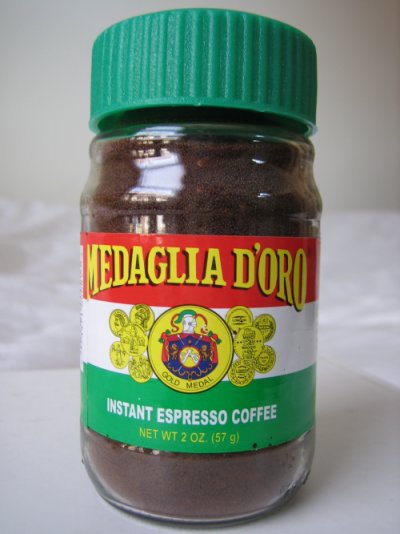
- (optional, but highly recommended) 1 teaspoon instant espresso powder (What the hell is instant espresso powder? It's basically the Maxwell House of the espresso world, and comes in a small jar that looks like this, and can be found at Whole Foods, and Cardullo's, in Harvard Square. I only ever buy it for this recipe, but it's worth it: it kicks the chocolate in the ass.)
- 3/4 cup boiling water
- 1 cup sour cream, room temperature (important!)
- 8 3/4 ounces (1 3/4 cups) unbleached, all-purpose flour
- 1 teaspoon table salt (prefer plain old table salt here to kosher or sea salt, though either is a reasonable substitute)
- 1 teaspoon baking soda
- 1 1/2 sticks (12 tablespoons) unsalted (important!) butter, room temperature (important!)
- 14 ounces (2 cups) packed light brown sugar
- 1 tablespoon vanilla extract
- 5 large eggs, room temperature (important!)
- (optional) confectioner's sugar, for dusting the cake
Preparation
First things First:
- Adjust your oven rack to the lower-middle position.
- Turn on your oven to preheat at 350 degrees. (If the oven ends up pre-heated early, while you are still working, this plays in your favour. The oven only tells you when the air inside is hot enough, and, when you open the door, all that air escapes. If your oven is pre-heated for long enough, the hot air heats the oven walls, and then the oven recovers more rapidly after you open the door and place the cake in.)
- Take out your ingredients that you want brought to room temperature. (I generally leave mine on or near the stove while it's heating, to help things along.)
For the Pan:
Melt the 1 tablespoon of butter listed in the "Cake Release" part of the ingredient list, and stir in the 1 tablespoon of cocoa powder from the same section. Use a pastry brush to coat the inside of your bundt pan with this stuff.
(This is the alternative to buttering and flouring the pan. Buttering and flouring would work great, but would leave a buttery, floury residue on the cake. This method, on the other hand, will leave a buttery, chocolaty residue, which is more visually appealing.)
For the Cake:
Combine the cocoa, chocolate, and espresso powder in a medium, heat-proof bowl; pour boiling water over, and whisk until smooth. Cool to room temperature, then whisk in the sour cream.
(Notes on above step: 1. an electric kettle rocks for getting the water boiled fast. 2. a stainless steel bowl, a silocone trivet, and a good whisk are a great combo here. 3. Cooling to room temperature could take a long time, and who wants to wait? Option one: put the bowl on its trivet in the fridge or freezer while you measure out the dry ingredients. Option two: if it's winter, place the bowl by an open window and stir until the mixture is at room tempurature; this is fast! Stirring will speed things up; apparently the physics are similar to blowing air over hot food in a spoon to cool it down.)
In another bowl, whisk the flour, salt, and baking soda together to combine.
In a standing mixer fitted with a flat beater, beat the butter, brown sugar, and vanilla on medium-high speed until pale and fluffy, about 3 minutes.
(This step helps incorporate air into the cake, so try not to skimp. If you have only a hand mixer, break that out; if you have only a hand, use a wooden spoon, and consider it your cardio for the day!)
Reduce speed to medium, and add eggs one at a time, mixing about 30 seconds after each addition, and scraping down the bowl with a rubber spatula after the first 2 additions.
Reduce speed again, this time to medium-low, (batter may seem separated: this is OK!).
Add about 1/3rd of the flour/salt/baking soda mixture and 1/2 of the chocolate/sour cream mixture and mix until just incorporated, about 20 seconds.
Scrape bowl and repeat, using 1/2 of remaining flour mixture and all of the remaining chocolate mixture, mixing until just incorporated.
Add the last of the flour mixture, mixing until just incorporated, about 10 seconds.
Scrape bowl and mix on medium-low, until batter is thoroughly combined, about 30 seconds.
Pour batter into prepared bundt pan, being careful not to pour batter on sides of pan. (A friend is handy here: one turns the bundt pan, one pours.)
Bake for 45 minutes and then test for doneness: poke a wooden skewer or wooden toothpick into the center of the cake, then pull back out; if there's uncooked batter, you're not done yet; if you're done, the wood comes out clean, ideally with a crumb or two attached.
If you're not done yet, bake for 5 more minutes, and test again.
When you're done, cool the cake in its pan for 10 minutes.
After the cake has cooled in its pan for 10 minutes, invert the cake into a wire rack, ideally lined with parchment paper (parchment paper not essential, just nice to have).
Cool the cake to room temperature, about 3 hours.
Now that the Cake is Cool...
- You could dust it with confectioner's sugar
- You could serve it with sweetened whipped cream with a bit of lime or orange juice folded in
- You could serve it with sweetened (or not) creme fraiche
- You could serve it with raspberry sauce
- You could serve it with strawberry sauce
- You could not mess with perfection, and eat it plain!